The Science of Sweating: Composition, Benefits, Toxin Elimination, and Sauna Connections

Disclaimer
This article is for educational and informational purposes only. It is not medical advice, nor a substitute for professional healthcare guidance. Individual responses to heat, sweating, or sauna therapy vary widely. Consult a qualified healthcare provider before undertaking any new regimen, especially if you have pre-existing conditions or concerns about toxin exposure.
I want to continue my thoughts on the summer months and their effects on our health. The last three posts have been about sunlight. Now I want to talk about sunshine's other attribute, heat, and the consequent sweating it produces. Sweating is something we are all destined to do this summer. Sweating, or perspiration, is the body’s primary thermoregulatory tool. When core or skin temperature rises, the hypothalamus activates eccrine sweat glands—approximately 2–4 million distributed across the skin surface—to secrete fluid onto the surface. As this fluid evaporates, it dissipates heat, helping prevent overheating during exercise, in hot weather, or with fever. This process is highly efficient: humans can lose up to 2–3 liters of sweat per hour under intense conditions, making evaporative cooling far superior to other heat-loss mechanisms, such as radiation or convection, when ambient temperatures exceed skin temperature.
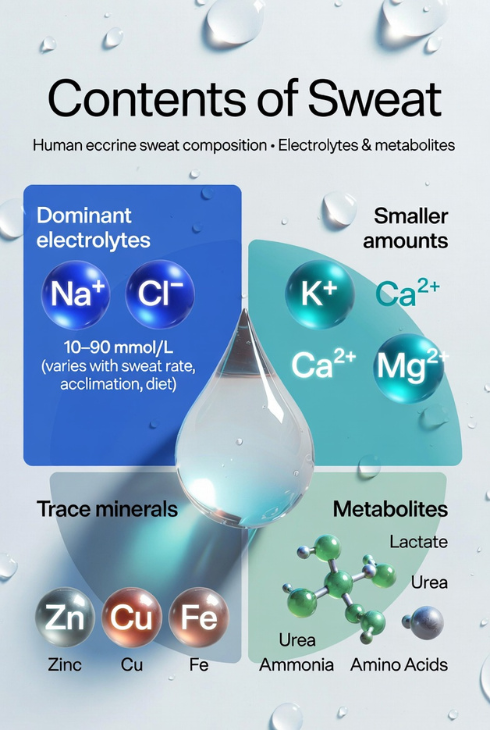
Scientific analysis shows sweat is overwhelmingly water—typically 99%—with the remaining 1% consisting of electrolytes and organic compounds. The dominant electrolytes are sodium (Na⁺) and chloride (Cl⁻), ranging from 10–90 mmol/L depending on sweat rate, acclimation, and diet. Smaller amounts of potassium (K⁺), calcium (Ca²⁺), magnesium (Mg²⁺), and trace minerals such as zinc, copper, and iron appear, along with metabolites including lactate, urea, ammonia, and amino acids. Urea, a byproduct of protein metabolism, and lactate from glandular activity or muscle metabolism are consistently present at millimolar levels. Proteins, cytokines, and cortisol can also be detected, though in nanomolar or picomolar concentrations. Apocrine glands (concentrated in axillary and genital regions) produce a thicker, lipid-rich secretion that contributes to body odor but plays a minimal role in thermoregulation.

A comprehensive 2019 review by exercise physiologist Lindsay B. Baker synthesizes these findings, emphasizing that sweat composition is not a simple filtrate of plasma. Instead, eccrine glands actively secrete and reabsorb solutes in the duct: sodium and chloride are partially reabsorbed under the influence of aldosterone during low-flow sweating, while lactate and urea may be produced locally by the gland itself. This dynamic process explains why sweat is hypotonic (less concentrated than blood plasma) and why its concentration varies widely with sweat rate, hydration status, and acclimatization.

The question of whether sweating meaningfully eliminates toxins has generated significant public interest and some scientific scrutiny. Proponents cite studies that detect heavy metals and organic pollutants in sweat. A 2012 review by Sears et al. examined arsenic, cadmium, lead, and mercury, concluding that sweating—via exercise or sauna—can excrete these elements, sometimes at concentrations higher than in blood or urine for certain metals, such as cadmium and mercury. Case reports, including one involving mercury normalization after repeated sauna sessions, suggest potential utility in reducing body burden. I used a sauna daily (and continue to) as a way to detoxify mercury toxicity from my profession.
A 2022 study by Kuan et al. directly compared heavy-metal excretion under two conditions: dynamic exercise (running) versus passive sauna exposure. Concentrations of nickel, lead, copper, and arsenic were significantly higher in sweat produced during running than in sauna-induced sweat, while mercury levels remained comparable. The authors hypothesized that exercise-induced metabolic stress mobilizes stored toxins more effectively than static heat alone.

Far-infrared (FIR) saunas enter the conversation here because they induce sweating through radiant heat that penetrates deeper into tissues (up to 4 cm) than traditional convective saunas. FIR wavelengths (approximately 5–15 μm) are absorbed by water molecules in the skin and subcutaneous layers, raising core temperature gently while prompting profuse sweating at lower ambient air temperatures (typically 40–60°C versus 70–100°C for conventional saunas). This makes FIR sessions more tolerable for longer durations, potentially increasing total sweat volume and exposure time to toxins. Preliminary research, including a 2022 analysis of water-filtered infrared-A (wIRA) sauna sweat, reported elevated inorganic ion excretion—including toxic elements—compared with exercise or wet saunas. Some commercial FIR studies and the landmark BUS (Blood, Urine, Sweat) protocol have documented higher cadmium, mercury, and other metal concentrations in FIR-induced sweat.
However, the scientific consensus remains cautious. Multiple reviews emphasize that the absolute quantities of toxins excreted in sweat are minute relative to daily intake or the primary detoxification routes of the liver and kidneys. Sweat is not a major excretory pathway for most xenobiotics; the liver metabolizes, and the kidneys filter the vast majority of toxins. Claims of dramatic “detox” via sweating often overstate the evidence, and large-scale randomized trials measuring pre- and post-intervention body burden are still lacking. Sweating’s benefits appear more reliably tied to cardiovascular conditioning (mimicking moderate exercise), improved endothelial function, and relaxation rather than wholesale toxin clearance. FIR saunas, in particular, show promise for cardiovascular health—comparable to brisk walking in some studies—but detoxification remains a secondary, modestly supported effect at best. I am glad it worked for me and my toxic mercury levels!

Beyond potential minor detoxification, sweating confers clear thermoregulatory and adaptive benefits. Regular heat exposure (exercise or sauna) improves sweat-gland efficiency: trained individuals produce more sweat at lower core temperatures and conserve electrolytes better. This heat acclimation enhances endurance in hot environments and may support broader metabolic health. I have no problems coping with our hot, muggy summer days here in the northeast. Sauna use, including FIR variants, has been linked in observational studies to reduced risk of cardiovascular events, possibly through repeated mild cardiovascular stress and improved vascular compliance.
Important Warnings and Safety Considerations
While sweating is beneficial, overexertion in heat carries real risks. Heat exhaustion—marked by heavy sweating, dizziness, nausea, weakness, and rapid pulse—occurs when fluid and electrolyte losses outpace replacement. Progression to heat stroke (core temperature >40°C, cessation of sweating, confusion, or seizures) is a medical emergency. Dehydration exacerbates these dangers by reducing sweat rate and impairing cooling. Individuals with cardiovascular disease, kidney impairment, or those taking medications affecting thermoregulation (e.g., diuretics, beta-blockers) face heightened risk. Pregnant people, the elderly, and children also require caution. Always hydrate before, during, and after heat exposure; limit sessions to 15–30 minutes initially; and exit immediately if lightheadedness or discomfort arises. Consult a physician before beginning sauna or intense heat protocols.
References:
Baker LB. Physiology of sweat gland function: The roles of sweating and sweat composition in human health. Temperature (Austin). 2019;6(3):211-259. doi:10.1080/23328940.2019.1632145.
Sears ME, Kerr KJ, Bray RI. Arsenic, cadmium, lead, and mercury in sweat: a systematic review. J Environ Public Health. 2012;2012:184745.
Kuan WH, Chen YL, Liu CL. Excretion of Ni, Pb, Cu, As, and Hg in sweat under two sweating conditions. Int J Environ Res Public Health. 2022;19(7):4323.
Cho K, et al. Effect of water filtration infrared-A sauna on inorganic ions excreted in sweat. Int J Environ Res Public Health. 2022;19(19):12345. (Adapted from PMC9546416).
Centers for Disease Control and Prevention. Heat-related illnesses. Accessed via public health resources, 2026.
Mayo Clinic. Heat exhaustion: Symptoms and causes. 2023.